
Use Variables
Use dynamic variables in your labels, emails and calculations.
Efficient Custom Variable Management for WP Cost Estimation Forms
Learn how to create and manage custom variables to enhance the functionality and flexibility of your forms.
Managing Custom Variables
Access the Variables panel by clicking the "Variables" button on the form edition panel toolbar:
Variables Panel
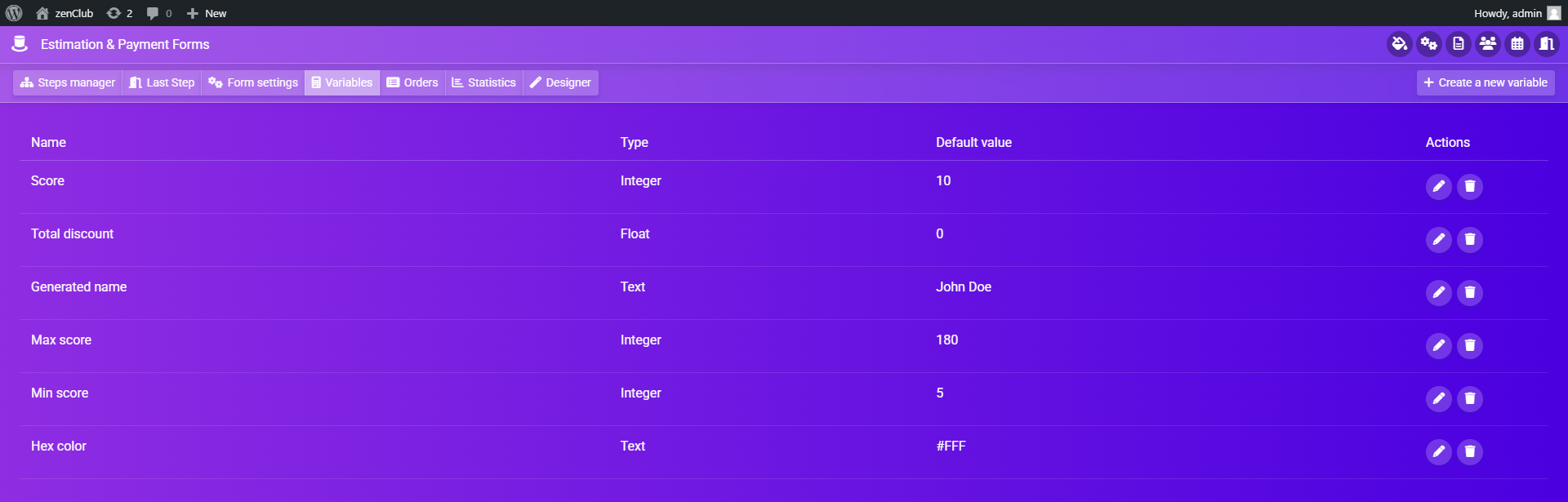
The Variables panel lets you define custom variables for use in your form's calculations and conditions.
Alter a variable upon selecting a specific component by opting for the "Modify a variable" in the "Price & Quantity" section of the component's edit panel.
Creating and Editing Variables
Adding Variables
To add a new variable, click "Add a variable." This will open a dialog where you can configure your new variable.
Editing Variables
To modify an existing variable, press the pencil icon next to it. This allows you to change the variable's properties.
Variable Types
Variables come with a title and type, including integer, float, or text. Choose the appropriate type based on what kind of data you need to store.
Integer
Whole numbers without decimal points. Useful for counting items or representing quantities that can't be fractional.
Float
Numbers with decimal points. Ideal for prices, measurements, or any value that might include fractions.
Text
Alphanumeric characters. Perfect for storing names, descriptions, or any textual information.
Using Variables in Components
Variables can be modified by components in your form, allowing for dynamic data storage and manipulation.
Modifying Variables in Components
You can set a component to modify a variable by selecting the "Modify a variable" option in the "Price & Quantity" section of the component's edit panel. This allows you to update variable values based on user input or calculations.
Example: Tracking Selected Options
Create a variable called "selectedOption" and set different components to modify this variable with different values. You can then use this variable in calculations or conditional logic elsewhere in your form.
Displaying Variable Values
Show variable values in "Custom content" sections or emails by using the "Add dynamic value" in the text editor toolbar.
In Custom Content
When editing a "Custom content" component, you can insert variable values using the "Add dynamic value" button in the editor toolbar. This will insert a shortcode that displays the current value of the variable.
In Email Templates
Similarly, you can include variable values in your email templates to personalize communications with customers.
Your order has been received. The total cost is [variable-2].
Thank you for your business!
Practical Use Cases
Personalization
Store customer information like name, company, or preferences in variables to personalize the form experience and communications.
Intermediate Calculations
Use variables to store intermediate calculation results that need to be used in multiple places throughout your form.
Conditional Logic
Variables can be used in conditional statements to control the visibility of form elements or to determine pricing based on complex conditions.
Data Aggregation
Collect and aggregate data from multiple form fields into variables for easier processing and display.
Pro Tip: Variables are especially powerful when combined with conditional logic and calculations. For example, you can create a variable that tracks the user's progress through a multi-step form, and use it to show different content or apply different pricing rules based on how far they've progressed.